Competitor gap analysis for AI answers
Find the sites and pages the AI engines read when they recommend a competitor instead of you, then work through them as a list, with the evidence attached.
- Closed beta
- free
- your own DataForSEO key
Checks five engines
- ChatGPT
- Gemini
- Perplexity
- Claude
- Google AI Overviews
At a glance
Named them, not you
Answers that named a tracked rival and left you out, with their pages.
A gap score you can recount
Rivals named, summed across gap answers.
Domains, hosts or URLs
One table, filtered by domain type or competitor.
One work list
Content, outreach, brand credit and crawlers, refreshed for free.
A brief for each page
Written from what the engines said.
28 days before and after
Each done action, measured like for like.
The unit is an answer
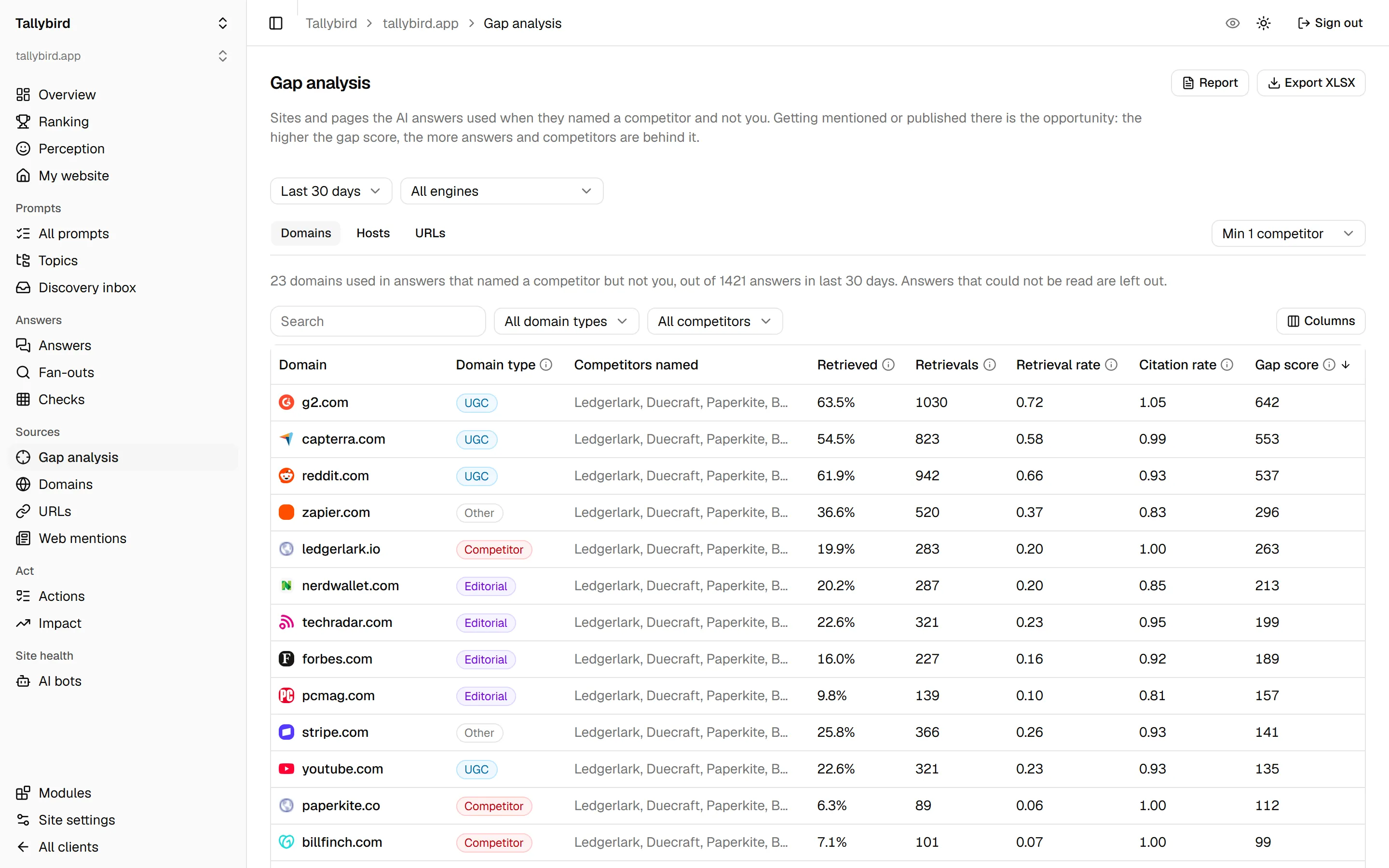
In AI search visibility gap analysis the unit is an answer: one prompt, one engine, one reply that named at least one tracked competitor and didn't name you. The app takes the sources citation tracking collects and looks at which domains, hosts and pages those replies used. Getting mentioned or published there is the opportunity.
Some other trackers show gap views too. Best AI visibility tools compares which ones do, with prices checked on their own pages.
Competitor gap analysis, two ways
- Classic SEO
- Keywords a rival ranks for and you don't.
- AI search
- Answers that named a rival and not you.
Domains, hosts or single pages
The table switches between Domains, Hosts and URLs. For each source it shows the domain type, the competitors named, how often it was retrieved, its retrieval and citation rates, and the gap score.
Filter by domain type or by competitor, or keep only sources whose gap answers named at least two or three different rivals between them.
Strict on purpose
- Answers that couldn't be readLeft out.
- An unknownNever counted as a gap.
- Your own domainNever shows up as one.
From a table to a work list
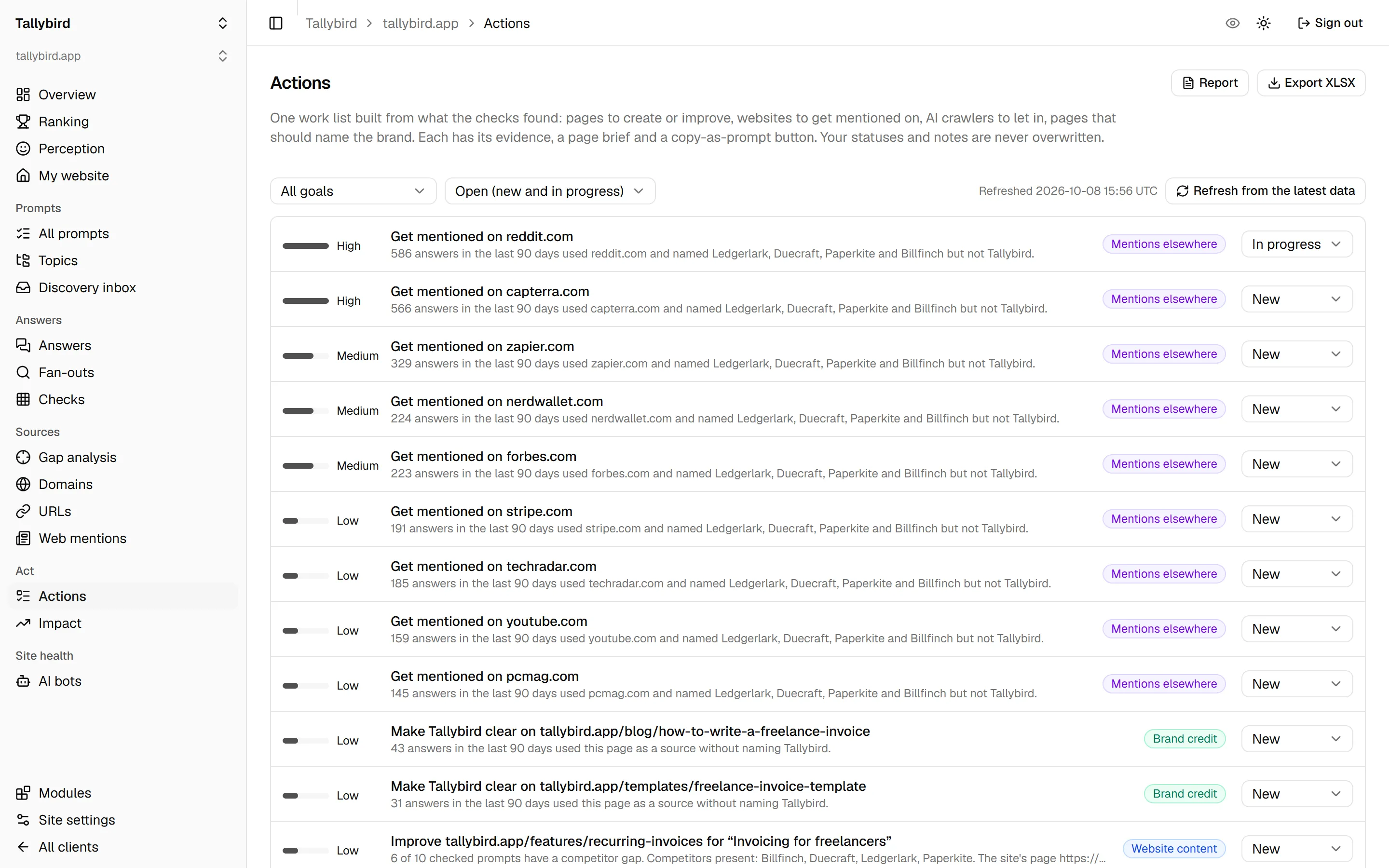
Actions turns the gaps into one list, rebuilt from stored data by a free refresh. Only asking the engines costs money, and pricing shows what that comes to.
Blocked crawlers show up before any check: the AI crawler check finds them for free, on any site.
Four kinds of action
- Website contentFor a topic where competitors are named and you aren't, create a page or improve the page of yours already cited.
- Mentions elsewhereGet mentioned on a third-party site with a gap score of at least 2 over the last 90 days. The top 10 make the list.
- Brand creditMake the brand clear on a page of yours that answers used without naming you.
- AI crawlersLet in a search or user crawler that robots.txt blocks.
Every item carries its evidence
In the demo, for example: "586 answers in the last 90 days used reddit.com and named Ledgerlark, Duecraft, Paperkite and Billfinch but not Tallybird."
Items are rated High, Medium or Low by the answers behind them, compared with the biggest action on the site. Your statuses and notes are never overwritten by a refresh.
A brief for the page that should win
For a content gap, the answer panel can write a page brief from the answers stored for that prompt: what to do first, what the answers rewarded, and what the page should cover.
The copy-as-prompt button on each action hands the task over in one paste, whether the page gets written by a person or with an AI.
Impact: what changed after
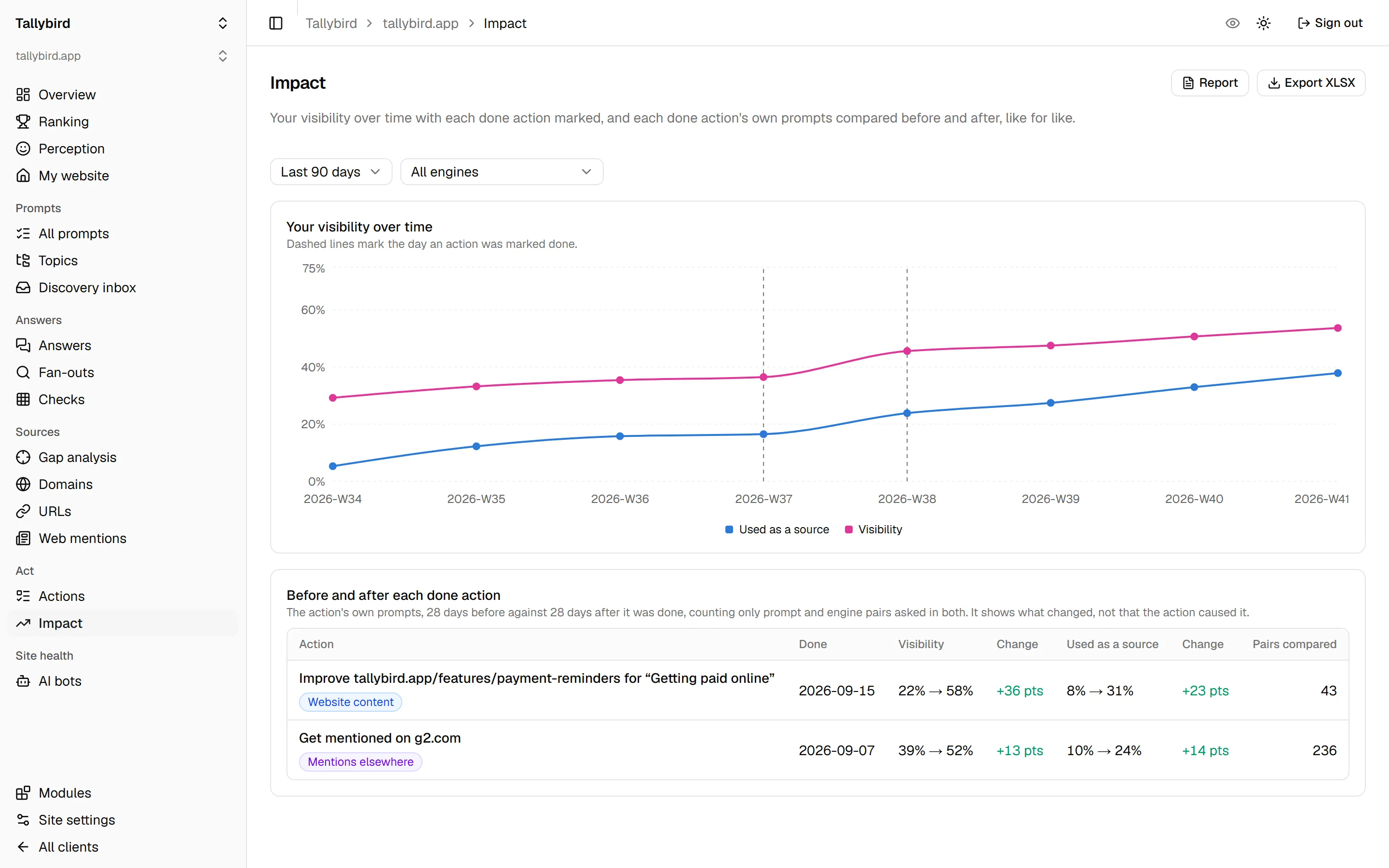
Mark an action done and Impact puts a marker on the visibility trend, then compares that action's own prompts in the 28 days before and the 28 days after. Only prompt and engine pairs asked in both windows count, so new prompts can't inflate the result. With no shared pair yet, it says there's nothing to compare.
It shows what changed after the action, not that the action caused it. AI answers move for many reasons, and I'd rather the page said so than took credit for the weather.
How the gap score is worked out
For each source, the gap score adds up, across its gap answers, the number of tracked competitors each answer named. The formula is written on the page, so you can check it against the answers yourself.
- Comparison page: 40 gap answers × 3 rivals
- 120
- Blog post: 40 gap answers × 1 rival
- 40
- Outreach and brand credit look back
- 90 days
From prompt to fix list
The full walkthroughFind the prompts
Discovery, your own list or both. Keep the questions a buyer would ask.
See the quote, then run
Pick prompts and engines. Nothing runs until you confirm the price.
Get the fix list
Gaps and Actions turn the answers into pages to write and sites to get on.
Questions
Which competitors does it compare against?
The ones you track for the site. Ranking also lists brands the answers name that you don't track yet. Track one and every stored answer is re-read at no cost, so its gaps appear straight away.
Can I compare gap scores between sites?
Not usefully. The score is a sum, so it grows with the number of answers and the number of competitors you track. Use it to rank sources within one site and one period.
Does refreshing Actions cost anything?
No. Actions are built from answers already stored. Only asking the engines costs money, and that always comes with a quote first. What a check costs
How far back does it look?
Gap analysis covers the period you pick. Outreach and brand-credit actions look at the last 90 days.
Get an invite.
I'm letting people in a few at a time. Leave your email and the site you'd track first, and you'll hear from me when your account is ready.
See pricing