AI citation tracking, down to the page
See which sites and pages the AI engines use when they answer your prompts, what kind of site each one is, which ones are rising, and which of your own pages they read.
- Closed beta
- free
- your own DataForSEO key
Checks five engines
- ChatGPT
- Gemini
- Perplexity
- Claude
- Google AI Overviews
At a glance
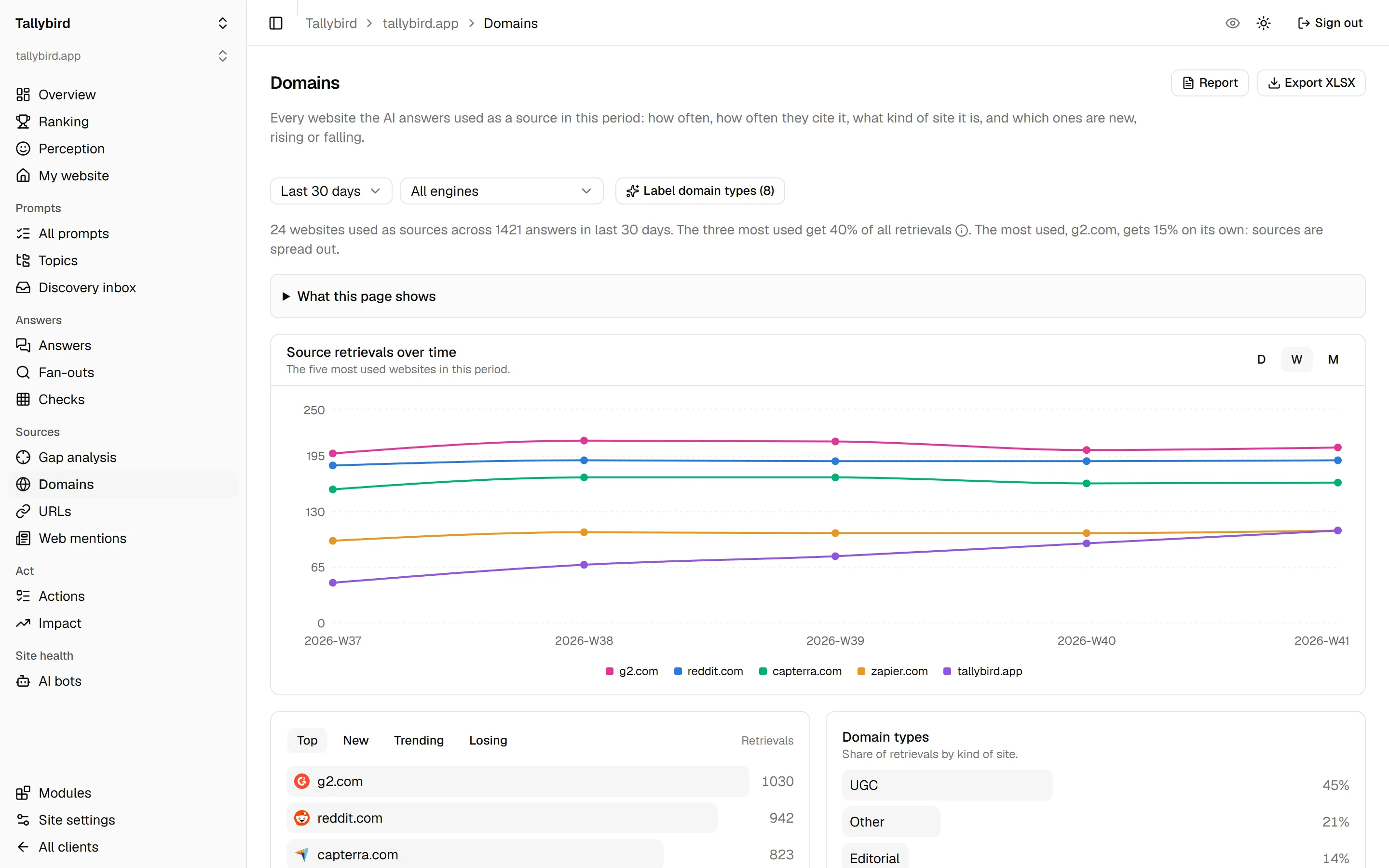
Every source, every engine
Each domain and page an answer cites, wherever the engine returns sources.
A type for every domain
You, Competitor, Editorial, UGC, Reference and three more.
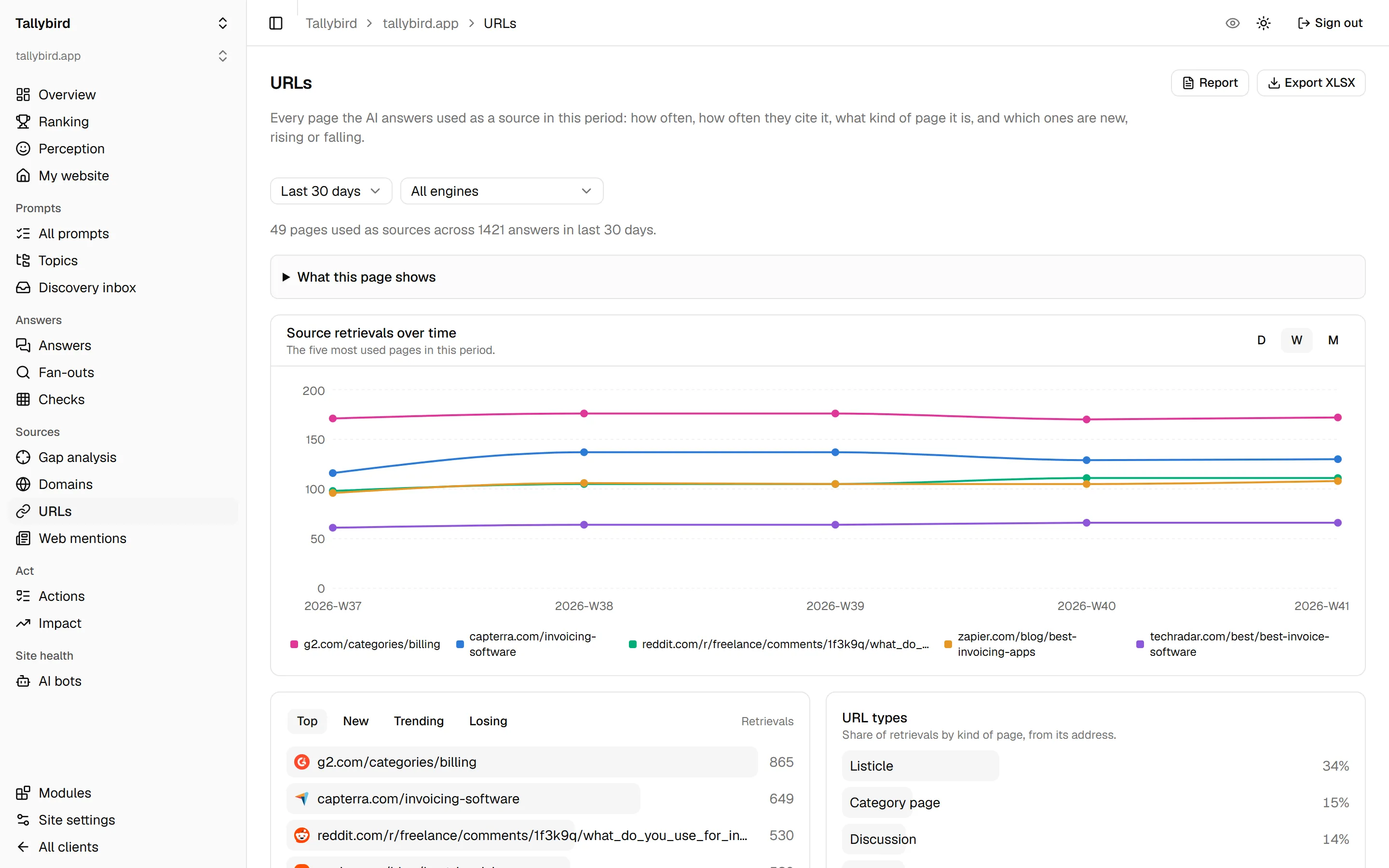
A type for every page
Listicle, comparison, how-to guide and seven more.
Top, new, trending, losing
Each source against the previous period.
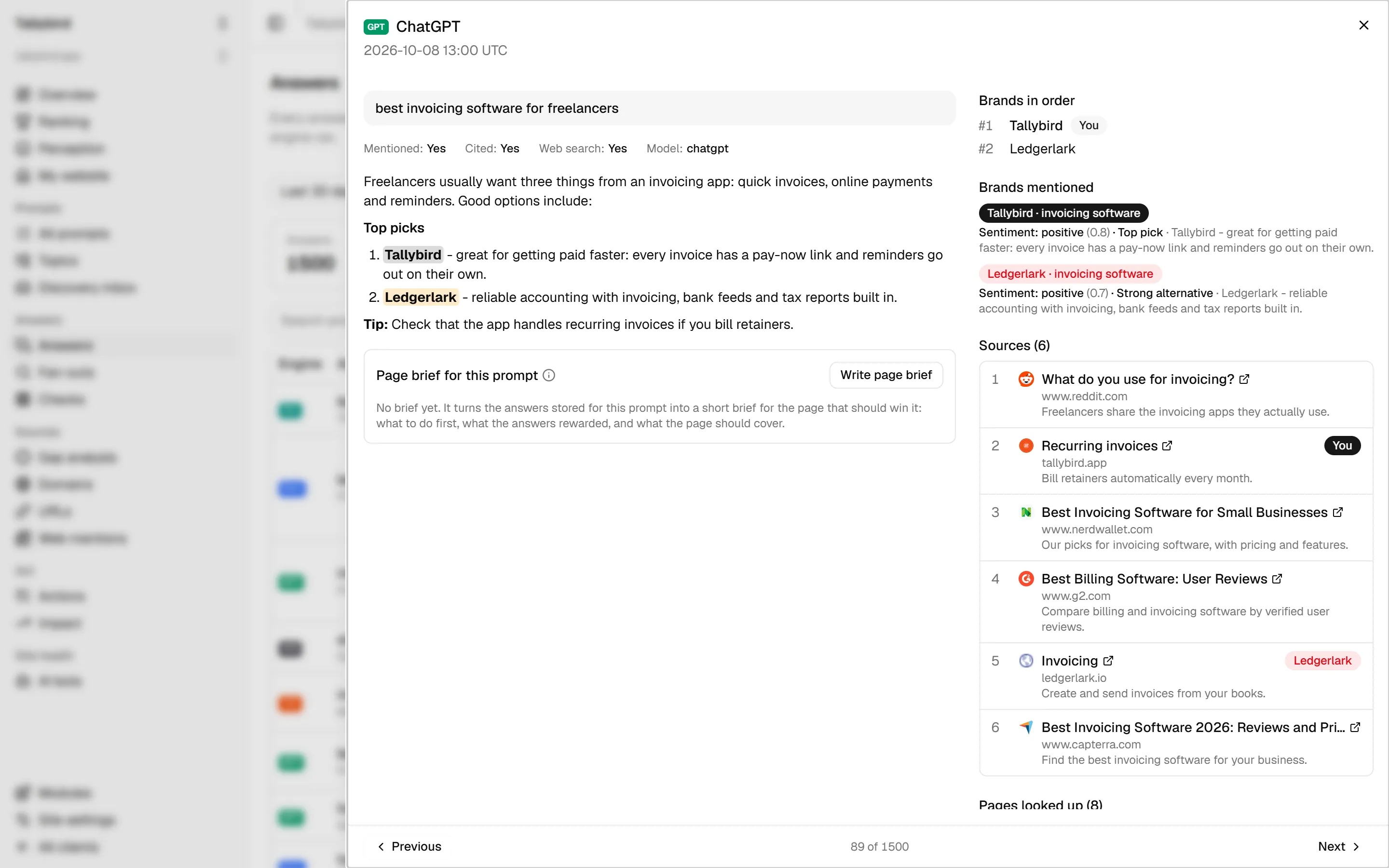
Your own pages, read
Pages used without naming you turn into actions.
One citation per row
A Citations sheet in the XLSX export.
A mention is not a citation
An AI answer can name your brand without linking your site, and link your site without naming your brand. Citation tracking covers the second half: the pages an engine used to build its answer.
It reads the answers that AI visibility tracking collects. For each one the app keeps every source with the words it was shown with and, for ChatGPT, which reports them, the pages it looked up along the way.
One page, one row
Pages are counted under a normalised address, without utm_ parameters or fragments, so one page doesn't split into five rows.
A domain is the registrable domain, so a blog subdomain counts toward its parent. A host keeps the subdomain, for when you need to tell a help centre or a regional edition apart from the rest.
One cited link, counted three ways
- As the answer linked it
- https://en.wikipedia.org/wiki/Invoice?utm_source=chatgpt.com
- Page
- en.wikipedia.org/wiki/Invoice
- Host
- en.wikipedia.org
- Domain
- wikipedia.org
Every domain gets a type
Each cited domain is typed as You, Competitor, Corporate, Editorial, UGC, Reference or Institutional, and Other when nothing fits. Your site and your competitors are labelled first. Built-in rules then handle well-known sites, government and education suffixes, and docs or support hosts. For the rest there's an optional AI pass that sees only domain names and is quoted before it runs.
The type tells you what kind of work a source needs.
What the type asks of you
- EditorialPitch a writer.
- UGCA forum or a review platform: show up where buyers already talk.
- ReferenceA listing or an entry that has to be accurate.
Top, new, trending and losing
Domains and URLs each open on four views. Top ranks sources by retrievals in the period. New lists sources first used inside the period. Trending and Losing compare retrievals with the previous period of the same length.
URLs also get a page type, from the address or from the page title when the address doesn't say: Homepage, Category page, Product page, Listicle, Comparison, Profile, Alternative, Discussion, How-to guide or Article. In the demo, listicles take a third of all retrievals; in a market like that, the lists are the place to be. Every domain and every URL also has a page of its own.
My website: which of your pages they read
My website turns the same data around. It lists the pages of your site that the engines read, and the answers where you were cited without being named. Look at those pages first: the engine already uses them, and the brand just isn't clear on the page. Each one becomes a "make the brand clear" item in Actions, with the number of answers that used it.
None of your pages on the list? A page AI bots can't read can't be cited. The free AI crawler check tests your robots.txt against about 50 AI crawlers.
From sources to outreach
Citation tracking tells you which sites the engines trust in your market. Competitor gap analysis narrows that to the sources behind answers that named a rival and not you, ranked by a gap score, and Actions turns the top ones into outreach tasks.
For the raw rows, the XLSX export has a Citations sheet with one citation per row: prompt, engine, citation rank, domain, URL, page title, and whether it was your domain or a competitor's. Reports and XLSX export lists the other sheets.
How citations are counted
One retrieval is one answer using one page. Each source shows its retrieval rate next to its citation rate, which is citations per answer that used the source.
An AI Overview shares its page with Google's organic results. Those are Google's ranking, not pages the AI read, so they stay out.
- A page in the answer's own source list
- citation
- A page read but not listed
- retrieval
- An engine that returns no sources
- left out
- Organic results beside an AI Overview
- not counted
From prompt to fix list
The full walkthroughFind the prompts
Discovery, your own list or both. Keep the questions a buyer would ask.
See the quote, then run
Pick prompts and engines. Nothing runs until you confirm the price.
Get the fix list
Gaps and Actions turn the answers into pages to write and sites to get on.
Questions
What counts as a citation?
A page in the answer's own list of sources. Pages an engine read without listing them (ChatGPT reports these) count as retrievals, not citations. For Google's AI Overview, the organic results on the same page are Google's ranking, not pages the AI read, so they are left out.
Does it track citations on every engine?
On every engine that returns sources. An engine that doesn't is left out of the used-as-a-source rate instead of counting as zero.
Can I get the raw citation list?
Yes: the Citations sheet of the XLSX export, one citation per row with clickable URLs, never a list of links in one cell.
Get an invite.
I'm letting people in a few at a time. Leave your email and the site you'd track first, and you'll hear from me when your account is ready.
See pricing