AI brand monitoring, answer by answer
How often the AI engines name your brand, in what order, how they describe it, and who they name instead. Six rates, each one traceable to the answers behind it.
- Closed beta
- free
- your own DataForSEO key
Checks five engines
- ChatGPT
- Gemini
- Perplexity
- Claude
- Google AI Overviews
At a glance
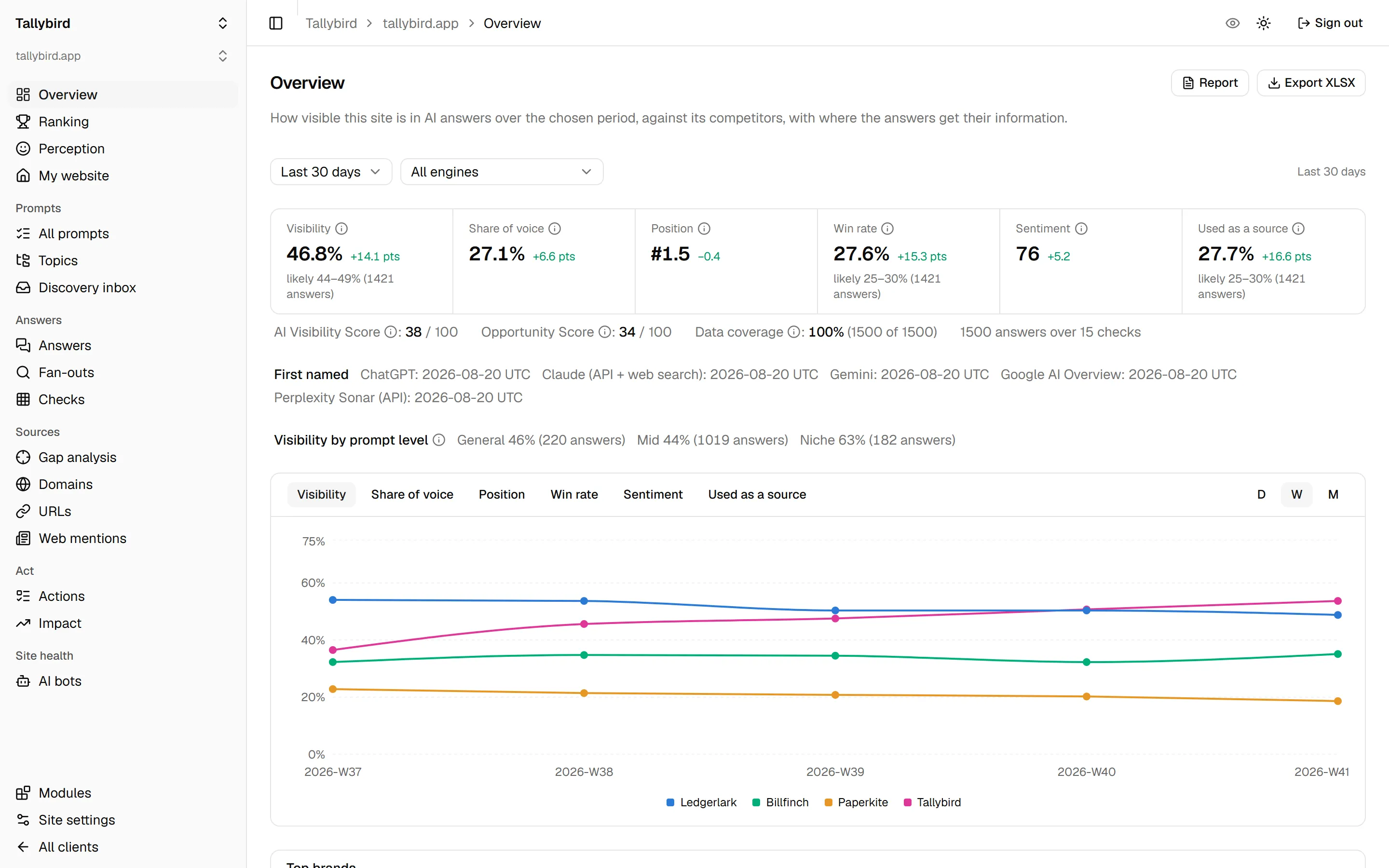
Six rates, each defined
Plain definitions, the same for every brand.
You next to every rival
Your rates beside each competitor's, from the same answers.
The brands you forgot
Names the answers use that you don't track yet.
Sentiment, read not guessed
0 to 100 over analysed answers. A dash, never a made-up 50.
Perception, once a month
Attributes, objections and a fact-check of claims about you.
Mentions beyond AI
News, Wikipedia and Wikidata for free; Reddit as an option.
Six rates, each defined
AI brand monitoring here starts from the answers that AI visibility tracking stores. Each rate is worked out per brand, so your AI brand visibility sits next to every competitor's.
The headline rates follow the definitions popularised by Peec AI.
Rate, and what it means
- Visibility
- Share of answers that name the brand
- Share of voice
- The brand's share of all tracked-brand mentions
- Position
- Average order in which the brand is named, among tracked brands
- Win rate
- Share of answers that name the brand first
- Sentiment
- 0 to 100, over analysed answers only
- Used as a source
- Share of answers that cite the site
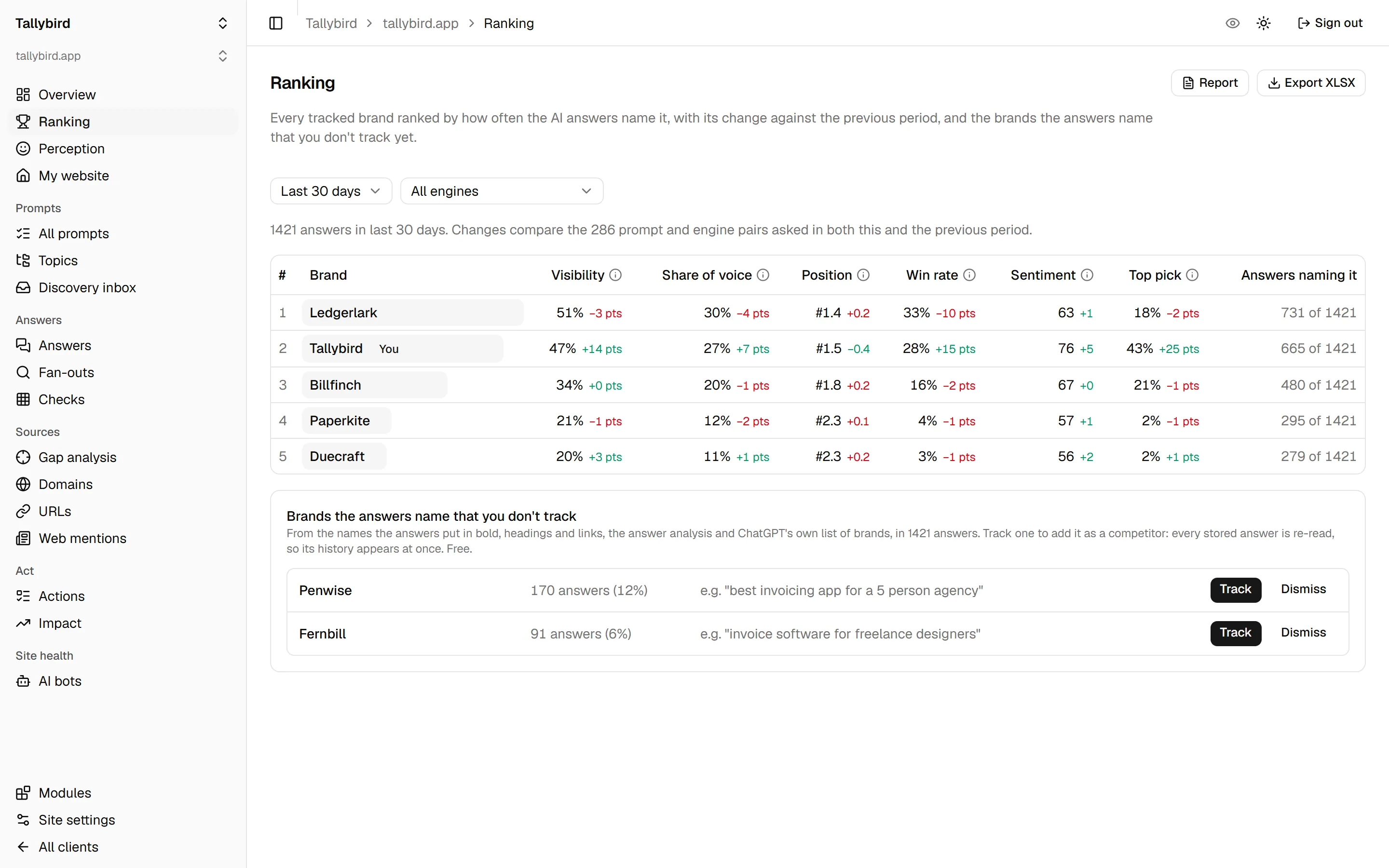
Ranking, including the brands you forgot
Ranking lines up every tracked brand by visibility, share of voice, position, win rate, sentiment and top pick, each with its change from the previous period. Under the table it lists the brands the answers name that you don't track yet, with their spellings grouped and an example prompt for each.
Track one and it becomes a competitor. Every stored answer is re-read for free, so its history shows up at once instead of starting from today. Bring that list to a client meeting: it names the rivals nobody put on the brief.
What other trackers charge, checked on their own sites, is on the best AI visibility tools page.
Sentiment means reading the answer
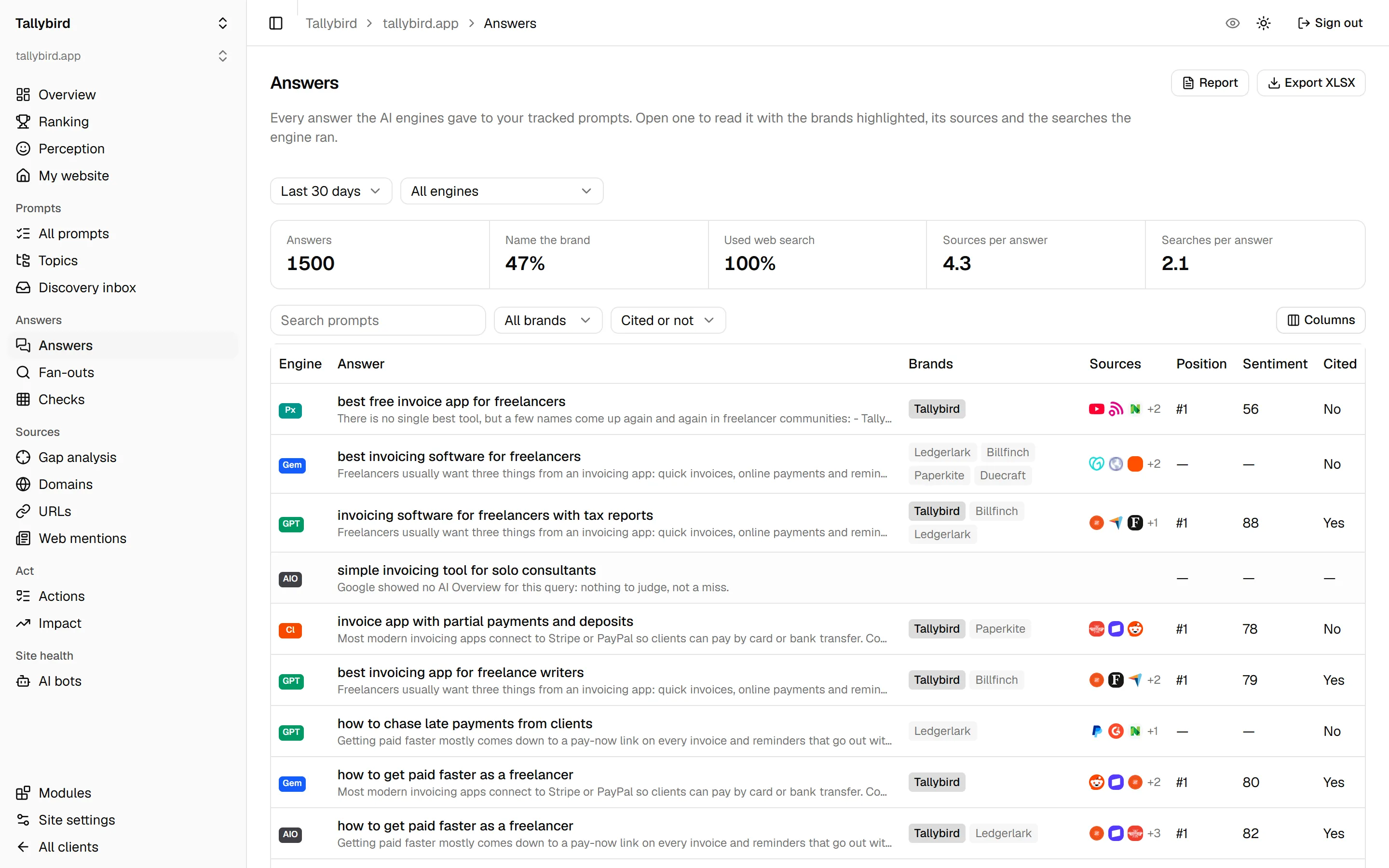
Counting mentions and their order costs nothing, because the app matches brand names in text it already has. Sentiment needs an AI to read each answer, so it lives in the Answer analysis module. After each check it reads every answer for the brands in order, a sentiment per brand and a recommendation label such as top pick. Analyse answers runs it on a single check.
A reply the AI couldn't read is stored as analysed with no verdict, never as neutral: I'd rather show a dash than a made-up 50. Like every paid module, Answer analysis is off until you turn it on.
Perception: how the answers describe you
The Perception module reads deeper, once a month. You pick the attributes that matter in your market, say "easy to set up" or "good for agencies", and write down facts about the brand. It then reads up to 150 answers from the last 30 days that name a tracked brand.
It asks the engines nothing new; it works from answers already stored.
What Perception reports
- An attribute score per brandHow often the answers that name it credit it with each attribute.
- ObjectionsCounted once per answer, with the engines that raised them.
- A fact-checkClaims about you against your facts: contradicted first, then not covered, then supported.
Mentions outside the answers
Web mentions looks for the brand outside AI answers: in the news, on Wikipedia and on Wikidata, for free, and on Reddit as an optional weekly module. To see which sites feed the answers themselves, use citation tracking.
One Overview for all of it
The Overview pulls it together: the six rates, the AI Visibility and Opportunity scores, a trend per brand, the top sources, and an alert when the latest check lost ground.
How the rates are counted
A change against the previous period is computed only on prompt and engine pairs asked in both periods, so adding prompts can't fake a gain. Visibility, win rate and used as a source carry a likely range, and a change whose ranges overlap is shown as normal variation.
Matching is strict: brand names count as whole words, a web address isn't a mention, and "Hub" isn't "HubSpot".
- Each answer counts
- once
- Sentiment
- 0 to 100, 50 is neutral
- Adding a competitor
- free
From prompt to fix list
The full walkthroughFind the prompts
Discovery, your own list or both. Keep the questions a buyer would ask.
See the quote, then run
Pick prompts and engines. Nothing runs until you confirm the price.
Get the fix list
Gaps and Actions turn the answers into pages to write and sites to get on.
Questions
Where do the rate definitions come from?
They follow the definitions popularised by Peec AI. Each answer counts once, and missing data is never shown as zero.
How is sentiment calculated?
Each analysed answer gives a verdict per tracked brand it names. The rate is 50 times one plus the average score, so 0 is all negative, 50 is neutral and 100 is all positive. Answers that weren't analysed, or couldn't be read, are left out.
Does a link to my site count as a mention?
No. A brand is mentioned when its name appears as a whole word in the answer. A web address isn't a mention, and a name that only appears inside a link doesn't count either.
Does tracking more competitors cost more?
No. Cost comes from asking the engines. Adding a competitor re-reads the answers you already have, for free.
What is the AI Visibility Score?
A 0 to 100 summary shown beside the rates: half weighted brand-mention coverage, half weighted citation coverage, with each prompt weighted by log(1 + AI search volume), or 1 when the volume is unknown. The formula is open and its parts are shown next to it.
Get an invite.
I'm letting people in a few at a time. Leave your email and the site you'd track first, and you'll hear from me when your account is ready.
See pricing